



Years of Excellence
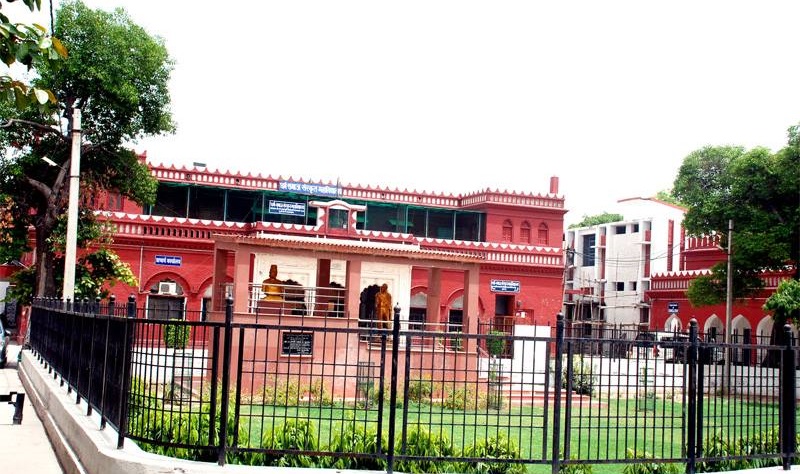
D.S. College, Aligarh is a prestigious institution of Northern India and the intitution effectively meets the academic needs of students comming from rural and urban background. It is the largest affiliated college of the Raja Mahendra Pratap Singh State University, Aligarh and accredited as B++ by NAAC. It is a premier institution, with highly qualified academicians imparting education in different fields. D.S. College has a rich alumnai network history of achievements in academics and other fields. Over the years, the college has produced distiguished alumni serving in vaious fields such as Chief Minister, Governors, Ambassador, Cabinet Minister, Member of Parliament, Member of State Assemblies, Judges, International Poets, Advocates, Social Workers, Scientists, Leading Industrialist and Educationists have been the students of this college.
D.S. College, Aligarh, Uttar Pradesh, India, is organizing the International Conference on Artificial Intelligence in Smart Education on 11–12 September 2026. The conference aims to bring together academicians, researchers, educationists, industry professionals, and policymakers from India and abroad to deliberate on the emerging role of artificial intelligence in transforming education systems. With rapid advancements in AI technologies, education is evolving toward smart, adaptive, and learner-centric models, making it essential to explore innovative practices and sustainable adoption. The proposed International Conference on Artificial Intelligence in Smart Education Its objective is to drive education forward – making it smarter, more inclusive and ready for whatever the future throws our way, all while keeping national and global goals in mind. The vision of the ICAISE- 2026 is to promote the use of AI in education among researchers and practitioners, working in a wide variety of following areas in Engineering, Science, Social Science, Enviromental Science and Management mentioned below:
The vision of the International Conference on Artificial Intelligence in Smart Education is to serve as a leading global forum for advancing knowledge, innovation, and responsible practices in AI-enabled education. The conference envisions fostering interdisciplinary collaboration to design intelligent, inclusive, and learner-centric education systems that leverage artificial intelligence for improved learning outcomes. It aims to promote ethical, transparent, and sustainable integration of AI in education while aligning technological progress with human values and societal needs. Through scholarly exchange and policy-relevant dialogue, the conference aspires to contribute to future-ready education systems that support equity, quality, and lifelong learning in a digitally driven global society.
The mission of the International Conference on Artificial Intelligence in Smart Education is to facilitate the exchange of high-quality research, innovative practices, and interdisciplinary perspectives on the application of artificial intelligence in education. The conference seeks to bridge academia, industry, and policy domains by promoting collaboration, knowledge sharing, and capacity building. It is committed to encouraging ethical, inclusive, and evidence-based adoption of AI technologies that enhance teaching, learning, assessment, and educational governance. Through scholarly dialogue and practical insights, the conference aims to support the development of sustainable, learner-centric, and future-ready smart education systems aligned with global educational goals.
Each submitted paper will be peer reviewed and only well researched and well written papers will be accepted for presentation. The presented papers will be publish in conference proceeding with ISBN Number and Selected Paper will be Publish in SCIE/Scopus/ESCI journals. After acceptance of the paper the candidate should proceed for registration on conference website. At least one author of each accepted paper is required to register and present their paper at the conference; otherwise paper will not be included in the proceedings.
Authors are invited to submit original and unpublished research papers that are relevant to the themes of the conference in the areas of Science, Social Science, Law, and Management. Submissions should not be under consideration for publication elsewhere.
Full-length papers should generally be between five and six pages in length, inclusive of tables, figures, and references. Manuscripts must be prepared on A4 size paper using Times New Roman font, with a font size of 14 for the title, 12 for the main text, and 10 for references. Line spacing should be 1.15, with one-inch margins on all sides. Papers must be submitted in MS Word format (.doc or .docx).
Each paper should include a clear title, author name(s), institutional affiliation(s), and email address(es), followed by an abstract of 200–250 words and four to six keywords. The main text should normally include an introduction, literature review, methodology, results and discussion, conclusion, and references.
References should be formatted consistently using APA or IEEE style, as specified by the conference. All submissions will be checked for plagiarism, and the similarity index should not exceed 15 percent, excluding references. Papers will undergo a double-blind peer review process, and acceptance will be based on reviewers’ recommendations.
At least one author of each accepted paper must register and present the paper at the conference. Selected high-quality papers will be considered for publication in conference proceedings, edited volumes, or peer-reviewed journals, subject to additional review and editorial requirements.